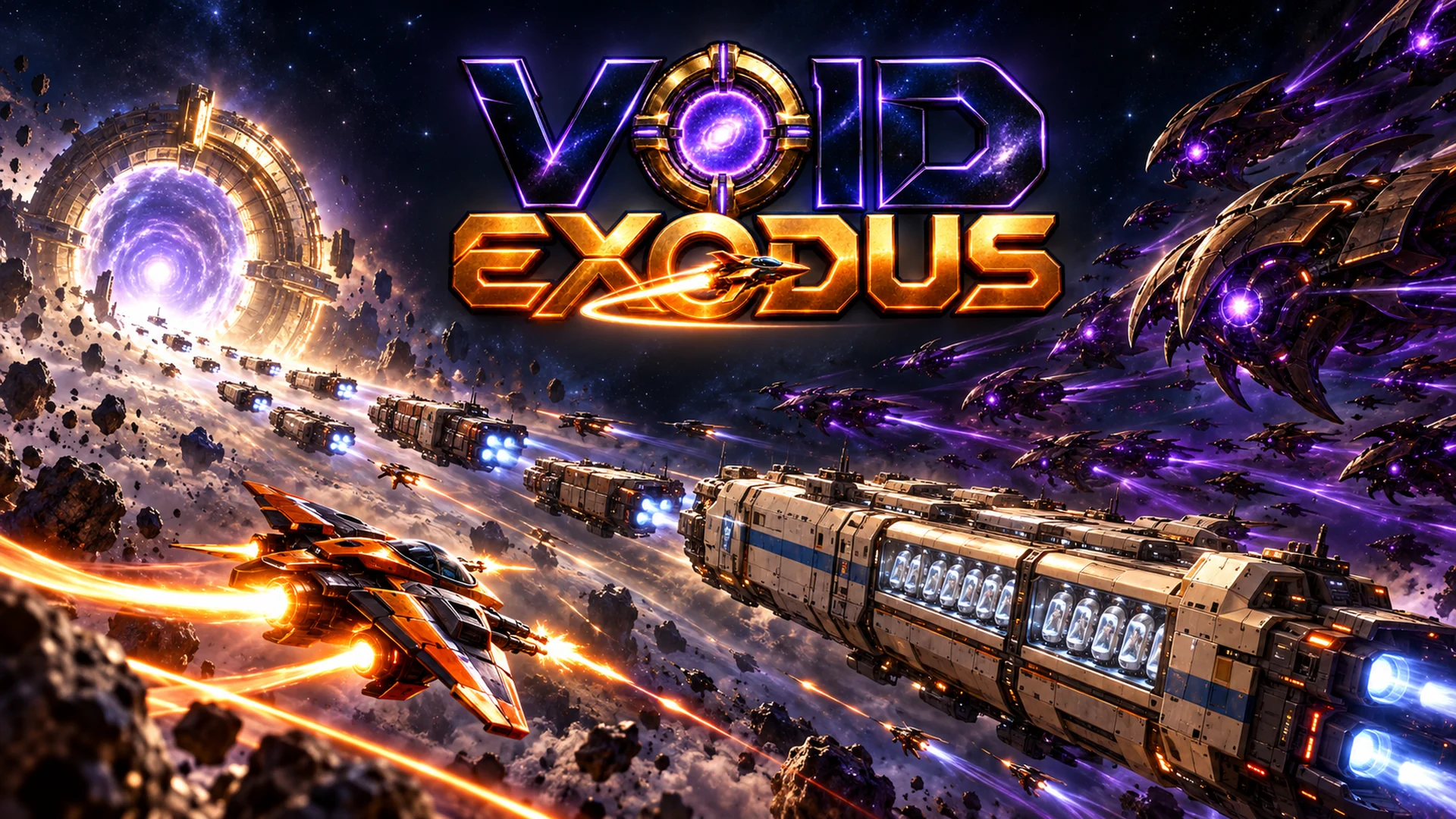
The premise in one paragraph
Thirty-one ships have left the colony of Halcyon together. The line calls itself the Halcyon Exodus, and it is running for Harrow's Gate, a passage that opens once and then stays shut for eleven years. You fly the escort fighter Lifeline. Your pilot is Nia, whom everyone on the radio calls Ember, and her reason for flying is asleep in a cryo bay aboard the Meridian, the slowest freighter in the line: her younger brother, Teo. Everything in the campaign, from which targets you protect to which shots you hold back, comes back to keeping that ship moving.
The crew you hear on the radio
Void Exodus tells its story in short radio calls during a fight, in a few painted panels when a chapter ends, and in one line from the crew each time you return to the convoy. You never sit through a long cutscene, so it pays to glance at the portrait in the lower left when a call comes in. Calls are short, and many carry the tip you need for the fight in front of you.
| Name on the radio | Who they are | What they tell you |
|---|---|---|
| EMBER | Your pilot, flying the Lifeline | Her own reactions. When she says Teo's name, the Meridian is in trouble. |
| CAPTAIN VARRO | Ilse Varro, commanding the flagship and the whole line | Orders, the state of the convoy, and the hard calls nobody else wants to make. |
| ORA | The mind that lives in the Lifeline's core | Tactical advice: which part to break first, what a hazard does, when an enemy is open. |
| MOSS | The convoy's mechanic | Runs the workshop between runs. Salvage in, upgrades out. |
| KADE | A pilot with a past in this sky, and a history with Ilse | Arrives in chapter 2 on the wrong side of your guns. Where he ends up is part of the story. |
Listen to ORA above everyone else in a boss fight. Her lines name the weak point for each phase, often a few seconds before the phase banner tells you anything.
The fold: what dying means
When the Lifeline's hull reaches zero, the run ends with the words LIFELINE FOLDED. The ship's core folds the cockpit back home to the convoy, so Ember lives, but every fold costs ORA a memory. Back at the convoy the crew card tells you what went: a name, a date, a detail of the world you left. ORA warns you on the radio when your hull drops under 30 percent, and that warning is worth respecting.
In practical terms, a fold sends you back to the convoy with the salvage you earned on that run. You restart the chapter from its first sector, at level 1, with whatever workshop upgrades you have bought. Nothing about the convoy itself is lost: ships leave the line because of the story, never because a run failed.
The Hush
The convoy's real problem is not pirates or mutineers but the Hush. It is less a villain with a plan than a tide: something in the dark that follows light. Where it feeds, stars go out. Its brood is drawn to whatever shines brightest, which turns light into both your weapon and your bait. From chapter 4 on this is the main rule of the game: a starshell you light pulls the swarm toward it and then burns them; the Meridian's running lights pull them toward her.
The first three chapters show the Hush only at a distance. The rogue drones in chapter 1 are the convoy's own security drones, turned against it by something that rewrote their guardian AI. The pirates of chapter 2 and the mutineers of chapter 3 are people under pressure, and the pressure is the dark ahead.
The Meridian
The Meridian is not a target you can shoot through. Its hull stops your own shots, and if you try, the game prints HOLD FIRE: CRYO DECKS across it. Only its engine block at the stern can be hit. Enemy fire stops on the hull too, so in a pinch she is cover. When she is on the field and under threat, a hull bar floats above her. Her shields always hold the last tenth of that bar, so she cannot be destroyed outright, but how much hull she keeps decides your medal for the chapter (see Star map, routes and medals).
The Gate clock
The convoy screen between runs shows two numbers: days left to Harrow's Gate and ships still in the line. The clock moves only when you clear a chapter, not while you retry one, so there is no penalty for losing a run and trying again. It starts at 88 days and 31 ships.
| Chapters cleared | Days to the Gate | Ships in the line |
|---|---|---|
| 0 | 88 | 31 |
| 1 | 80 | 31 |
| 2 | 68 | 31 |
| 3 | 56 | 28 |
| 4 | 42 | 27 |
| 5 | 30 | 27 |
| 6 | 12 | 27 |
The sector title card at the start of each sector also counts down: three days pass between sectors. In the last chapter the counter changes from days to the Gate into days until it closes, starting at eleven.
The road to the Gate
The route runs through seven chapters and a short epilogue, Other Sky. Each chapter has its own corner of space and its own trouble: a hijacked guardian at the first gate, a pirate reach, a dead nebula where the rations fail, the edge of the dark where the Hush is waiting, the graveyard of a convoy that tried this before you, the starless Gulf, and finally the Gate itself. The campaign chapter walks through each one sector by sector.
Twice the story stops and asks you to choose. In chapter 3, two ships have run dry and there is fuel for one. In chapter 6, Ilse gives an order about the Meridian that Ember may not want to follow. Both choices change what happens next and leave a mark on the star map, and both are covered without spoilers in the star map chapter.
Reading the story as you play
- Radio calls never interrupt play. If two arrive at once, older news is dropped rather than read late.
- The crew card at the convoy changes with your last run. After a fold it tells you what ORA lost; after a clear, someone sets up the next chapter.
- Story panels after a boss can be clicked through, or advanced with Space, Enter or the right arrow.
- The final chapters reveal a great deal about ORA, the Hush and why the convoy is being hunted. This guide stops short of all of it.