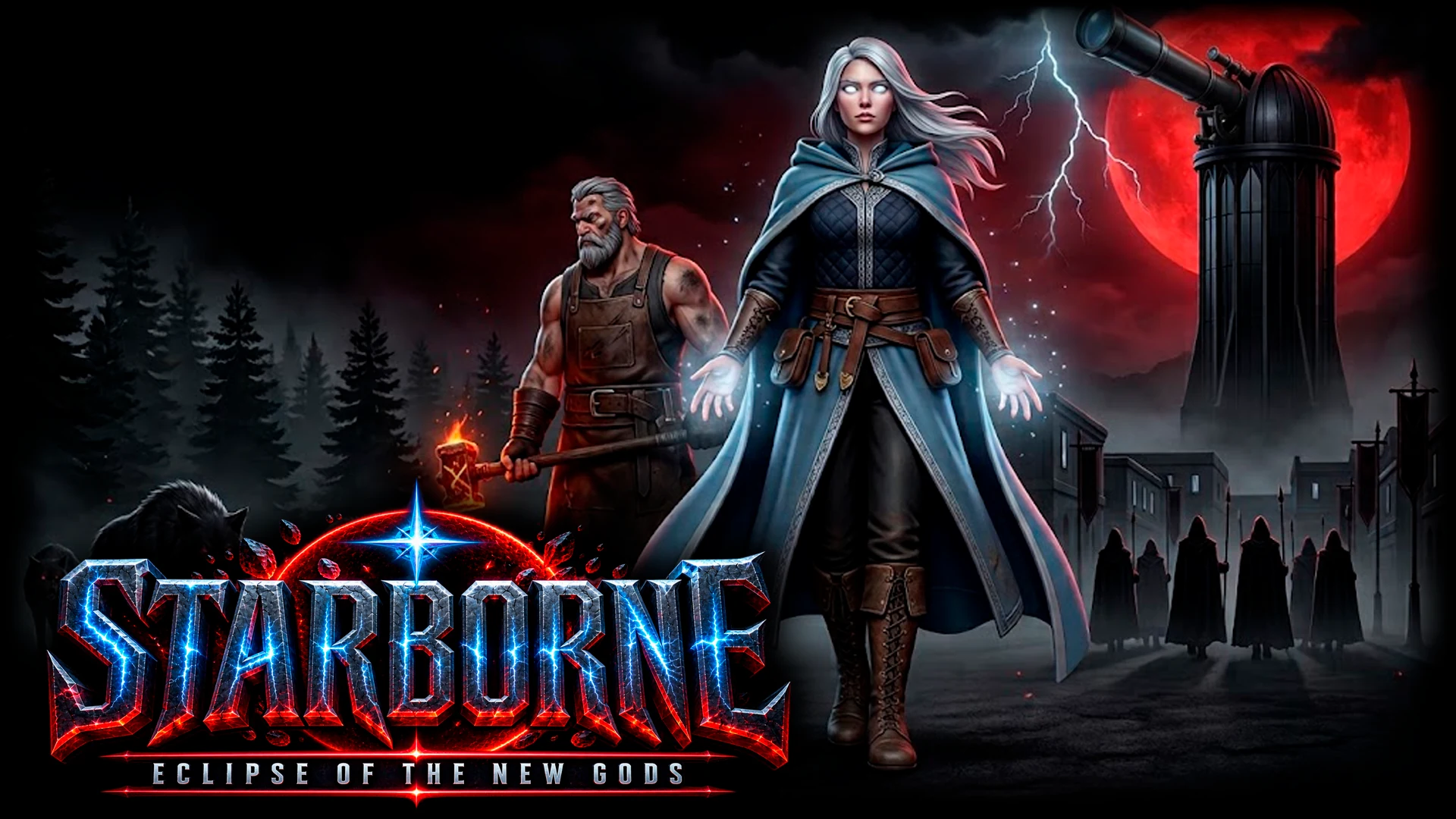
Eclipse of the New Gods
Eclipse of the New Gods is the novel Starborne is built on. It is Volume I of the Starborne saga, and it tells the same story the game does: a valley under a torn Veil, a blacksmith and his Starborn daughter, and a Ministry that counts villages until there is nobody left in them to count.
The book and the game are not two versions competing for the same story. The book is the source. Its characters, places, magic and tone are the canon the game is built from, and when the two disagree, the book's version is the one that stands. If you want to know what Starborne is really about before the game is finished, the novel is where to look.
How to read it
| Details | |
|---|---|
| Series | Starborne, Volume I |
| Free to read | Chapters 0 to 3, the first four chapters |
| Complete volume | $4.99 |
| Languages | English and Portuguese |
| Where | In the studio's online reader: read Eclipse of the New Gods |
The free chapters begin at chapter 0, so you start the story where it starts, not partway in. Four chapters is enough to know whether this world is for you.
What the book gives the game
Much of what makes Starborne feel like itself comes straight from the novel's pages.
- The magic. The book's magic runs on blood, nails, counting and ash, and so does the game's. There is no generic spell system underneath: rituals have a cost, and numbers matter.
- The enemy's method. The idea that the Ministry takes a village by auditing it, counting bowls and chairs and doors, binding the bell-ropes in hair and salt and carving a square with a line through it, is the book's. So is the image of what is left: fires burning, doors open, no voices.
- The places. Brakktun, Harmony (the copper-pipe place) and the landmark called the Tooth, with a taken village west of it, are all from the novel.
- The look of the Veil. The book describes the Veil as thin mouths in the air, slits of possibility, and the Tear as a black slab veined like a still ocean. The game's black glass is that slab.
- The people. Gideon and his mantra, Aurelia, Lyra with her red ribbon, Alex with his voice as cool as a coin, Keep and the dog with no name all come from the book. See Characters.
Each region is a chapter beat
The game's twelve regions are laid out so that walking the road is walking the book. Each region dramatizes a beat from the first volume. Kept spoiler-light, the pairing looks like this.
| Region | The beat it carries |
|---|---|
| Hearthvale | The opening tragedy, and the first wrongness in the woods |
| Brakktun | The Ministry crossing a village like auditors, and taking it |
| Harmony | The copper-pipe place, and what the Ministry pipes through it |
| Duskreach | The Ministry's lens: light as audit and exposure |
| Cinderhold | Gideon's ritual smithing: nails, ash, heat and the hammer mantra |
| Frostmere | The erased names, and the silence after a taking |
| Ravenmoor | The Ministry's deceptions, and rivals who return |
| Thornwall | The cost of ritual blood, and a world that feeds on the willing |
| Stormhall | The Ministry as armed enforcers, not just clerks |
| Sablefen | The Veil as thin mouths in the air |
| Gloamspire | The Ministry's false gospel of order through darkness |
| Concordia City | Arrival at the heart of the auditors, and Alex revealed in full |
The journey ends where the book's first volume ends, at the Black Glass Observatory. The game's final duel and the novel's climax are the same moment. For the regions themselves, see The twelve regions.
Where the game adds to the book
A novel and a game do different jobs, and Starborne is built to use both.
The book can stay with one person for a whole chapter, sit in Gideon's head while he works, and let a silence last as long as it needs to. The game cannot do that, but it can make you do the things the book describes. The book tells you a taking leaves the doors open. The game lets you walk through them. The book tells you light matters. The game makes you carry it.
The game also turns the story's ideas into a journey you complete yourself. The twelve Veil Medals are each an ability, and collecting them is how the road to the Ministry opens. At the very end the game is planned to ask you to choose between sealing the Tear and claiming it, a choice the small decisions of the journey are meant to lead up to.
Which first, book or game?
Either works. The game is being built to stand on its own, and you will not need the novel to understand what to do or why. But Starborne is in development, and the book can be read now. If the world described in this guide appeals to you, the first four chapters of Eclipse of the New Gods are the quickest way into it today.
Beyond Volume I
Eclipse of the New Gods is the first volume of a longer saga. The questions it opens, about what lies on the far side of the Veil and what the word gods really means there, are answered later. Starborne the game covers the first volume's road, from Hearthvale to the Observatory.