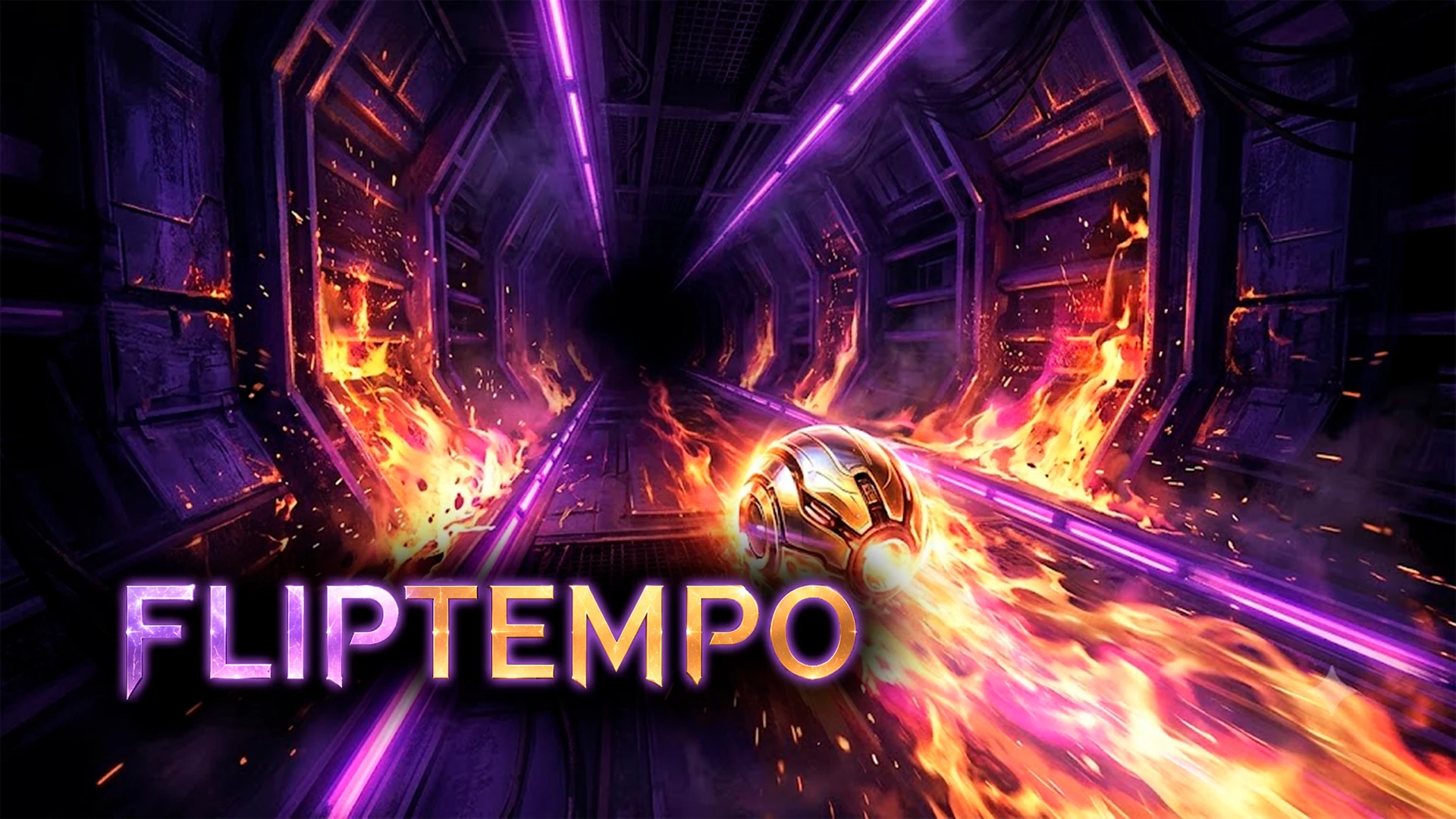
Fliptempo has three ways to play: the campaign, the Daily and Endless. All three use the same controls and the same scoring, and the Easy or Hard switch on the main menu applies to all of them.
Campaign
Thirty fixed levels across five worlds, cleared in order. Press Play and the game starts the next level you have not cleared yet. A crash restarts the same level straight away, timed to the music, with no menu in between, so a failed attempt costs you a second or two. The pause button in the corner opens the settings and pauses the run; switching to another tab or app pauses it too.
Because each level is built the same way every time, the campaign rewards memory as much as reflexes. The second attempt at a level is always easier than the first.
Stars
Reaching the finish gate earns a level's first star. Two further conditions decide the rest:
- All gems: collect every gem in the level, five on Easy or ten on Hard.
- Flip target: make at least the target number of counted flips before the finish.
Meet either one for two stars, both for three. A flip only counts toward the target if the ball actually travels a quarter of the corridor's height or more since the last counted flip, so tapping twice on the same wall does not help. The target is set at about nine tenths of the flips the level physically has room for, so it demands steady flipping from start to finish, not a burst at the end.
During a run a star tracker under the gem counter shows your flips against the target and your gems against the total, and it lights up as each condition is met. After a clear, the results screen lists all three conditions, shows your best run on that level (stars, flips and gems), and, if you fell short, says exactly how many gems or flips you were missing.
Stars are kept per difficulty and you keep the best result, so replaying a level can only add stars. Your stars on Easy and Hard together feed your rank, covered in The Garage, rank and trophies.
Easy and Hard
Both difficulties are open from the start, and each has its own unlock path, its own stars and its own best runs. Switching does not reset anything.
| Easy | Hard | |
|---|---|---|
| Level length | 100 + 4 × level number (104 to 220 m) | 330 + 10 × level number (340 to 630 m) |
| Speed | Base | 12% faster, in every mode |
| Gems per level | 5 | 10 |
| Layout | Its own fixed layout | A different fixed layout |
| Final screen | The Great Work | Magnum Opus |
Hard is not Easy with the dial turned up. A Hard level is roughly three times as long, so the back half of a Hard level is further into the speed ramp and further from the start than anything on Easy, and it carries twice the gems. Learning the Easy layout does not give you the Hard one. What carries over is your reading of each world's hazards.
A sensible order is to clear a world on Easy, then try its levels on Hard while the hazards are fresh. Hard also pays twice the gems per level, which matters once you start saving for the expensive crafts.
Daily
One short course a day, the same for every player. The layout comes from the date, so everyone playing on the same calendar day flies the same 200 metres.
- Three attempts a day. An attempt is spent the moment it starts, not when you crash, so quitting halfway to scout the course still costs a try. The menu button shows how many you have left.
- Stars work as in the campaign: finish for one, all gems or the flip target for two, both for three.
- Gems for stars. Your best Daily result pays 4 gems for one star, 9 for two and 18 for three. If you improve on a later attempt, you are paid the difference, so three stars over the day always totals 18. Gems you collect on the course are added on top, as everywhere.
- Daily stars do not count toward your rank. They only pay gems.
- The best score of the day is kept, and finishing seven different Daily challenges earns the Daily Devotee trophy.
The Daily starts a little slower than the first campaign level but speeds up faster within its course. With only three tries, use the first one to learn where the gems are, the second to collect them, and the third to chase the flip target.
Endless
No finish line and no stars: you fly until you crash, and the score is the point. Endless starts slower than any campaign level, then climbs steeply. Over the first 420 metres the speed rises to nearly double its starting pace and then holds there. The corridor keeps changing for much longer: over the first 3,600 metres it becomes steadily more pinched and wavier, which is where Endless runs are really decided.
There are no gems on an Endless course, so it is not a way to earn currency. It is where your multiplier and Surge skills matter most, since nothing interrupts a long chain except your own mistakes. Your best Endless score is saved and shown on the game-over screen, and scoring 50,000 in a single Endless run earns the Endless Legend trophy. Endless plays to Downtown's music.
Which mode when
- New to the game: campaign on Easy. The first levels are short and teach the flip.
- Saving for a craft: replay campaign levels, Hard for twice the gems, and play the Daily every day for up to 18 more.
- Practising chains and Surge: Endless, where a long run gives you time to build a high multiplier.
- Going for rank: three-star levels on both difficulties. Every star on Easy and Hard counts.