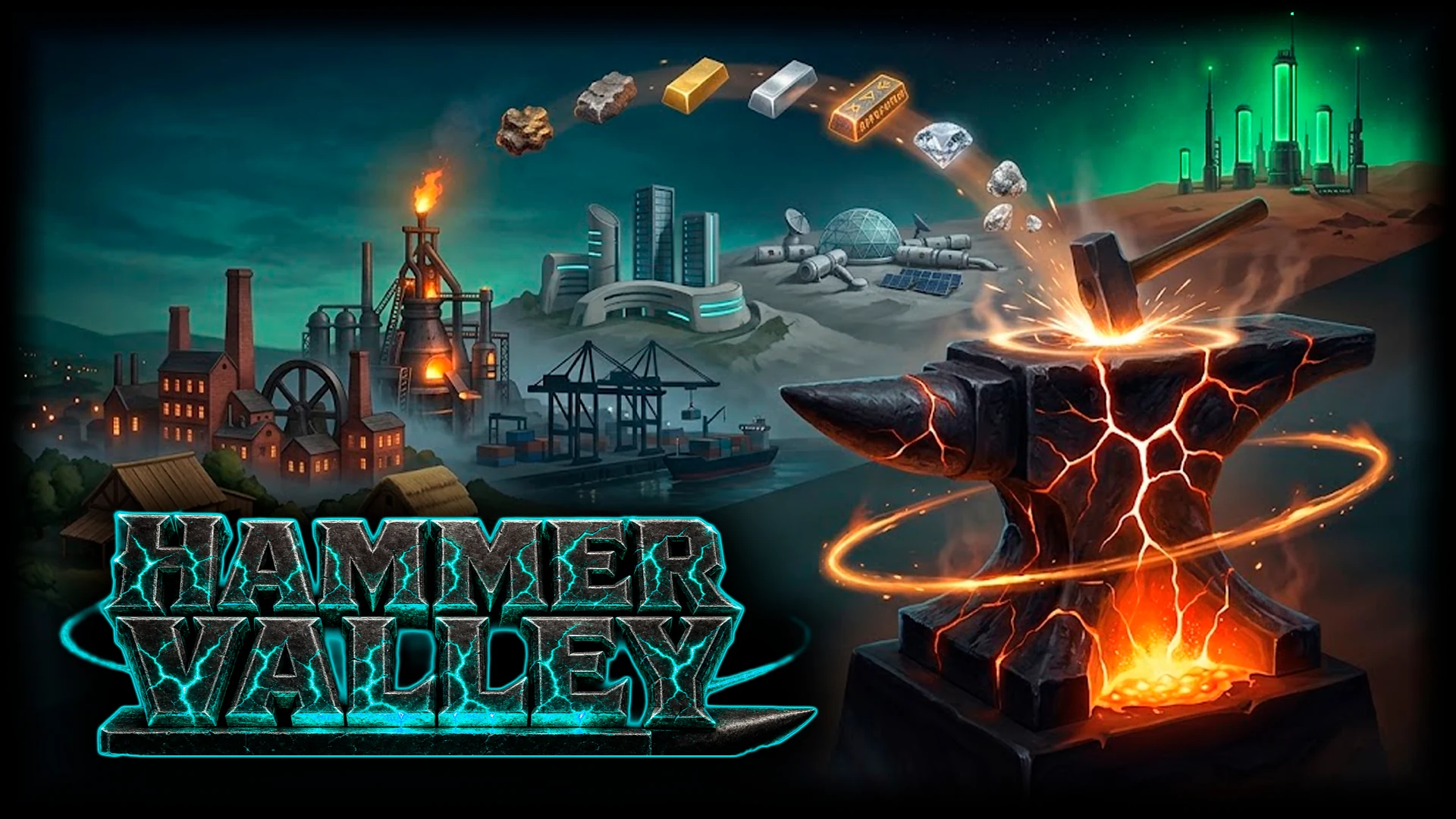
Idle games have a problem everyone in the genre knows about and few talk about: the numbers go up, and after a while nobody can say why they should care. Hammer Valley had that problem. You started with an anvil in a farming valley and could, in principle, build all the way to a colony on Mars, but nothing in the game told you why a smith would want to. This update is about fixing that, plus a set of smaller changes that came out of playing the first few minutes over and over until they felt right.
A reason to leave the valley
Hammer Valley now has a story, and it is a small one on purpose. Seven years ago your older sister, Wren, left the valley to chase a metal that supposedly never cools. She wrote once from every place she stopped. The last letter said three words: don't follow me.
Each of the seven sites in the game is somewhere she passed through, and each has a guide who knew her. Brann in the valley kept the hat she forgot on the bench. Wick in Ironbridge carried her letters and read every one. Sal in Steelhaven hired her and then fired her. Meg flew her out of Port Sable and still thinks she was a fool. Each of them remembers a different person, and none of them has the whole truth. You piece it together as you go.
We did not add a new system for this. The story rides on the guides that already walked you through each site. What changed is what they talk about. A guide who used to say "build the hut" now says why the hut matters, and occasionally, unprompted, tells you something about your sister. Her letters arrive at The Post, the building that used to be the Exchange. The Exchange was a leftover currency-conversion screen that almost nobody opened; it is now the place the story lives.
A full barn now actually stops you
This is the most consequential design change in the update. Before, when your barn was full, the game still quietly counted passive income in some places and not in others. The label said "Full!" and the number kept moving. It was a lie, and a confusing one.
Now the rule is simple and the game tells you about it: when storage is full, passive income stops. Every forge, belt and crew on the site waits until there is room. Your own hammer still pays, so you are never stuck, but the idle half of the game is paused until you expand storage. Each guide warns you in their own voice. Brann's version is roughly "the barn's brimming, boss, the forges have stopped."
We went back and forth on this. A hard stop feels harsh, and the easy answer in idle games is to make storage infinite. But storage is the one building in an idle game that asks you to come back and make a decision. Without it, offline progress just piles up and the game plays itself. With it, "check in, expand the barn, go" is a real loop, and the storage upgrade becomes one of the most satisfying purchases instead of the most forgettable.
The first ninety seconds
We replayed the opening from a fresh save dozens of times with one question: what does a new player have in their hands at the thirty, sixty and ninety second marks? The answers led to a handful of changes.
- No menu wall. The game now drops you straight into the valley. Brann speaks within two seconds, and the first objective is on screen before you have had time to wonder what to do.
- One objective at a time. The objective list used to show every goal on the map. It now shows only the one you are working on, and hides completely when a site is finished. The full history moved to the Ledger.
- A new order in the valley. Strike five times, build the furnace, house a crew, fuel the heat, then build the barn. Each step unlocks the reason for the next.
- Resetting replays it. Settings now has a two-tap "Start over" option that wipes your save and plays the opening again from scratch.
Playing on a phone
Mobile players now get a proper STRIKE button on the right thumb, with DASH above it and an EAT button beside it that shows what the current site's cook is making. The numbers that float up when you earn were hard to read against bright ground, so they are larger now and carry a solid dark outline.
Every site looks like itself
Speech boxes, buttons and panels used to share one generic look across all seven sites. Each site now has its own interface materials: oak and iron in the valley, walnut and brass in Ironbridge, riveted steel in Steelhaven, painted hull steel in Port Sable, glass in Silicon Reach, titanium with hazard striping on the Moon, and oxidised plate on Mars. It sounds cosmetic, but it changes how travelling to a new site feels: you arrive somewhere, rather than just seeing a bigger multiplier.
Small things
- Food now works the same way on every map, with a local dish and a local cook who talks like the site's guide.
- The valley's baker is no longer a painted figure. The baker kneads the dough, loads the oven, tends it, and a real loaf comes out each cycle.
- Several late-game sites were missing production lines, which made the jump from the Moon to Mars take weeks longer than intended. Those lines are now wired in.
- The guide arrow now points to the right building on all seven maps, including every late-game goal.
What's next
More of the valley's buildings are getting the baker treatment: people doing visible work instead of standing still. After that, balance passes on the later sites, where the pace still needs tuning. If you play and something feels slow, confusing or unfair, tell us. We read every message, and most of the changes above started as one.